Our History
UIC Tutorium History
Every story has a beginning.


One Director, Three Instructors, and 50 Students
The Tutorium in Intensive English opened in September 1978, with 1 director, 3 instructors, and about 50 students. The second director took over in early 1979, the third in 2000, and the fourth in 2018. At the beginning, there were 3 levels – beginning, intermediate, and advanced, and there were 2 courses at each level-Reading/Writing and Grammar/Conversation. Many students were part-time, studying Grammar/Conversation only.
The University of Michigan ESL materials such as Reading, Thinking, and Writing, Reader’s Choice, and English Sentence Structure were the initial curriculum; The Michigan Language Test, a 100-item, multiple-choice test of listening, grammar, vocabulary, and reading, was used for placement. PLATO computer-based grammar, reading, and vocabulary exercises and language lab-based listening and pronunciation drills were included in class activities. Due to classroom space limitations and a desire to make courses available to local working constituents, classes were held in the evening.
An additional level for advanced students was soon added, and the intensive program expanded rapidly into a 5-level program that offered three 10-week terms and one 8-week term per year to a diverse student body. A writing sample was also soon added to the placement procedure.
The growth of the Intensive program over the next ten years paralleled the growth of the field of ESL, including an explosion of new ESL materials, approaches, and techniques. Past curriculum development included a general writing curriculum, a pronunciation syllabus, listening, reading, and conversation guidelines and materials, and several versions of a grammar syllabus. Materials and files have consistently been organized by level and focus and available to all staff. Since faculty members have generally shared common office space and office hours throughout the history of the program, informal coordination of curriculum has been encouraged. In addition, a curriculum committee and the position of Curriculum Coordinator were also established. This position, initially rotating, developed into 2 permanent positions that included both teaching and administrative responsibilities.
Building a Foundation for Learning
Over the years, the program experimented with regular separate pronunciation instruction, adding a basic level, and offering an advanced “bridge” class. Some advanced students participated in independent study that included auditing university classes. The Institutional TOEFL was added as a service to our students, and an interview was added to the placement procedure. Final grade report conferences were eliminated.
Special courses separate from the intensive program were offered at various workplaces such as Bell Labs and Sergent & Lundy, and a TOEFL Preparation course was offered on campus. Significantly, the Tutoruim has coordinated with the UIC linguistics department to provide observations and internship opportunities for MA TESOL students as well as graduate assistantships. Over the years, this partnership brought well-trained new instructors into the program, kept the Tutorium up-to-date on the latest theories and methodologies and use of technology in the classroom. This partnership continued until the MA TESOL program ended in 2019.
A New Chapter in the Classroom
In the late 1980’s, major IEP curriculum revisions were prompted by two factors: a university changeover from quarters to semesters and a desire to meet the needs of the changing student population. When the new curriculum was implemented in the fall of 1991, changes in the length, structure, philosophy, and methodology of the program resulted in instruction being offered in two 13-week terms and an 11-week summer term each year. Full-time instructors on 10/12 contracts taught each semester. The program was divided into 4 levels, with two 2½-hour integrated-skills classes: Reading/Writing and Listening/Speaking. In Fall and Spring, classes were held Mon.-Thurs. from 3 – 9 pm. In Summer classes ran 9 am – 3 pm Mon. – Friday. At this time enrollment was over 100. A complete written curriculum was produced which increased emphasis on listening and speaking, focused on skills as well as knowledge, and reflected our increased understanding of the needs of adult language learners. All levels of testing were revised, and the position of Level Course Specialist, held by full-time instructors, was created to help maintain consistency across sections of the same level course.
The new curriculum also featured a special week of elective courses designed to offer content-based learning and student choice of focus. Throughout this period, student enrollment grew and the size of the faculty and staff also increased. Office space was expanded and improved, and special courses continued, particularly TOEFL Preparation.
Administrative work involving admissions, student services, marketing, finances, records, and all other elements of our small “school within a school” has been covered variously over time by an Associate Director, Business associate, computer lab director, Marketing person, Graduate assistants, an immigration advisor, and student workers.
Embracing Technology and New Possibilities
In the 1990s, technology became a major force for change at the Tutorium. The opening of SCAILAB, the acquisition of individual computers for instructors, and the hiring of technically-skilled staff allowed us to computerize our files, create a website, and develop email, Internet, and other computer-related skills which led to more use of computers for class activities and staff training. In addition, the purchase of video equipment led to increased use of videos for listening comprehension activities and increased filming of students for speaking skills development and staff training. Also, our placement data was fully computerized and individual student preference formally added as a factor in the placement process. Further, student course evaluations were revised to focus more clearly on specific areas and computerized to generate quantitative data about student satisfaction. In more recent years, technological advances increased the use of media and websites in the classroom and provided diverse methods of interactions between students and faculty. Keeping up to date with the ways technology can enhance the language learning classroom is now an integral part of the program.
As time went on, elective course offerings were revised. The lower level electives program was shortened to a half-day, and courses in such areas as poetry, singing, and Internet skills were offered. At the upper level, additional courses with writing, culture, performance, and computer focuses were added. Regular revision of elective courses has continued.
Special course offerings expanded, including contract courses for public school teachers and students. Responsibility for coordination of these special and contract courses was delegated to a Program Coordinator, The English for International Professional Series (EIPS), which included courses such as Advanced Writing and Grammar, and Conversation and Vocabulary Skills was developed, and various online and special courses were developed, some in partnership with the College of Business. By 2011, the EIPS program, headed by an Assistant Director, had become increasingly flexible, offering a variety of courses to meet the needs of its expanding customer base.
Old Class Photos


A Commitment to Excellence
Throughout the years, the Tutorium participated in various professional organizations and activities. The program underwent self-study and was awarded membership in the American Association of Intensive English Programs (AAIEP) in the spring of 2001. A lengthy and rigorous self-study and site visit led to accreditation from the Commission on English Language Program Accreditation (CEA) in December 2001. The CEA site reviewers noted particular strengths in student services and staff professional development in awarding us accreditation. Later, TIE underwent self-study and site visit processes to join University and College Intensive English Programs (UCIEP) in 2002.
Such self-study contributed to the improvement of the program in many ways, and continued CEA accreditation requires a regular review of all aspects of the program. It should be noted that no other IEP in the area holds membership in all three of the above organizations.
In Spring 2002, a 5th level, high advanced, was added, and in Fall 2002 immigration processing was transferred from UIC’s Office of International Services to a TIE Foreign Student Advisor. Enrollment around this time was over 150. In January 2003, the TIE main offices were relocated from free space in University Hall to rental space in the South Campus Complex, at 1333 South Halsted St., Suite 260, and we debuted a new TIE website in Spring 2003 and changes were made to the schedule. The Fall/Spring schedule changed to a 2-8 pm schedule in Fall 2004. This better met the needs of our F-1 students, and the expansion of the EIPS and other non-intensive courses helped to meet the needs of other students.
Continuing our focus on self-study and improvement, TIE applied for and received 10-year re-accreditation for the Intensive English Program from the Commission on English Language Program Accreditation (CEA) in spring 2007 and, in Spring 2012, submitted a 5 year interim report. The CEA response stated, “The program shows notable strengths in several standards areas, including in Curriculum, Administrative and Fiscal Capacity, Student Achievement, and Program Development, Planning, and Review.”
In the spring of 2011, a low beginning 6th level, called Intro, was added due to changing demographics and the increased number of students with very low skills.
Growing and Finding Our Place at UIC
Fall 2012 brought a return of Immigration processing to UIC’s Office of International Services and the beginning stage of UIC’s Bridge Program which was expected to bring great changes to TIE. While this did not in fact have a large impact, it began the process of integrating TIE into UIC a bit more.
The relocation of the office away from the central campus area in conjunction with continued technological development prompted multiple changes over time. Instructors used the office less often, materials began being housed in the Addams Hall rooms, and students interacted less with office staff in the office. Instead, office staff began making themselves available at break times near student classrooms.
In 2014, the full-time faculty became part of the new UIC non-Tenure track union, causing a significant and much needed increase in salaries.
2016 and 2017 brought the country-wide downturn in IEP program enrollments. Influences on TIE included the elimination of the Intro level, the reduction of faculty and extreme belt-tightening. Classes in the IEP were shifted to day hours in an effort to be competitive and ran from 9 am to 3 pm. This required great flexibility in room schedules although the program managed to maintain the structure of all RW and LS courses running concurrently.
In 2017, UIC created the Office of Global Engagement (OGE) and restructured, putting the Tutorium under OGE along with other offices connected to international education. At the same time, UIC contracted with Shorelight to bring a pathway program to UIC. TIE’s role was to provide all the English language teaching needed for the one-year accelerator program and to provide IEP services to those students not yet ready for the accelerator program. Classes for this program, called UIC Global, began in Spring 2017. A majority of students in the IEP were associated with UIC Global by 2019.
Becoming Part of a Global Community
In Spring 2017, the IEP received CEA re-accreditation for 10 years with no reporting requirements. In 2019, work began to add the EIPS and UIC Global classes to our accreditation.
Other large projects begun in 2019 focus on unifying the three programs as much as possible, creating efficiencies across the program, and working to enter TIE into the UIC systems. The Tutorium’s current (2024) organizational structure and multiple other changes reflect this focus. One significant example is the revamping of the IEP level 5. The courses are designed in such a way as to address the needs of three student groups (EIPS, level 5 IEP students, and graduate students) within each course. Additionally, as of Fall 2020, TIE courses moved into the UIC course listings under the ELSI rubric (English Language Support for Internationals). To integrate ourselves more effectively into the UIC structure, the IEP went from a 13 week program to a semester long program, eliminating electives, modifying the IEP grading, and transitioning the I-17 to the university’s I-17 under the management of the Office of International Services.
Contracts for faculty were adjusted from 10/12 to 9/12 to increase flexibility in teaching assignments across programs and address the lengthened semesters. This adjustment has worked effectively in Fall and Spring semesters. Staffing for summer sessions consists of a mix of adjuncts, current full-time faculty, or other UIC instructors. Contracts for faculty with administrative duties were adjusted to 12/12 positions.
Old Tutorium Photos


Shaping the Tutorium Today
The pandemic of 2020-2021, caused changes which will likely affect the program’s future. One result is that TIE’s role on campus has grown to include providing an English Language Proficiency Assessment for graduate and undergraduate students. Another is that all classes from the IEP through the Accelerator were held online only from the last part of the Spring 2020 semester through the summer 2021 semester and partially at other times until the end of the pandemic. This move undoubtedly enhanced the technological skills of all in the program, instructors and administrators alike. Now all courses have Blackboard sites which are used extensively. Also, during this time, Addams Hall (formerly known as SCAILAB) received upgrades to its wifi and projection equipment using grant money that UIC received to upgrade the technological infrastructure of the university. The program also used this time to develop other programs: online classes for marketing purposes and a TESOL Professional Development Series. While dealing with all these issues, TIE won an award from the UIC faculty union, and two instructors received awards from OGE.
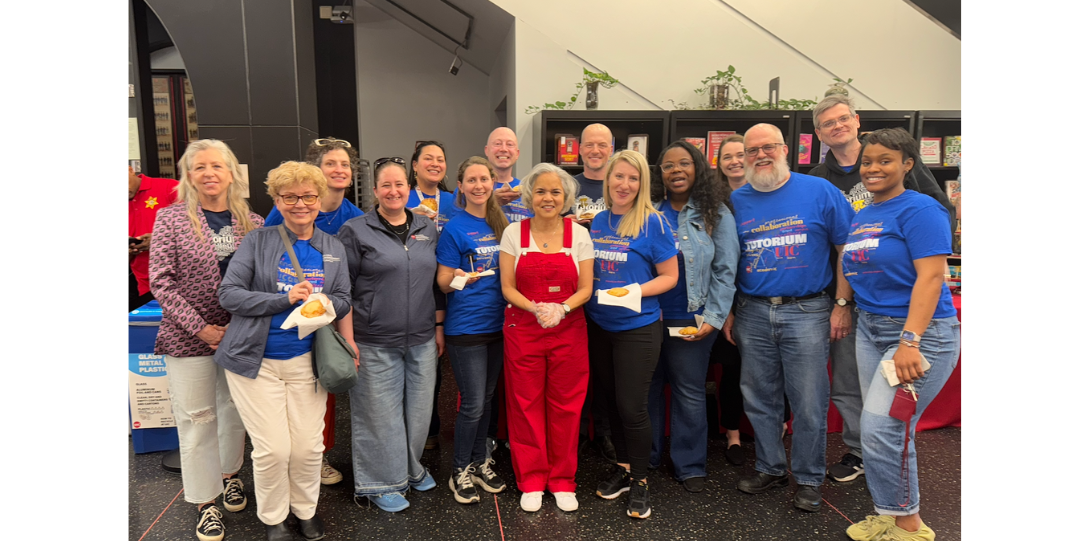
After returning to campus in Fall 2022, Tutorium reevaluated its space needs and over the next couple years managed to first downsize and then, in 2024, move the office spaces to Addams Hall. Because, as of the pandemic, students are now required to have their own laptops, one entire side of the Addams Hall computer lab rooms were reconfigured to create a public facing office area, administrative area, an instructor area, kitchen, and meeting space. This has proved convenient to students for advising and helpful in bringing instructors and administrators back together.
Continuing the work toward efficiency and taking advantage of natural staff attrition, administrative positions have been reduced, centralizing the academic support for the IEP and Global programs onto a single person and reconfiguring the Organizational Chart. All administrators continue to look for efficiencies in procedures and ways to take advantage of all that UIC systems have to offer.
As of January 2023, the Tutorium incorporated all of its programs under its accreditation with the Commission on English Language Program Accreditation (CEA). The name on record with CEA was changed from Tutorium in Intensive English to The Tutorium. The style guide on the use of the department’s name was created.
With the pandemic, the move to integrate into UIC, and the enrollment downturns, the past few years have been one of enormous change at the Tutorium. Nevertheless, under the Office of Global Engagement and due to a great deal of work on the part of all, the Tutorium has a much more significant place at UIC than in years past.
In May of 2025, UIC Tutorium began their 10 year CEA re-accreditation process. The decision was made to also begin a curriculum “reset” where the current curriculum is reviewed and modernized to address current student needs and enrollment trends.
Tutorium Leadership History
| Role | Name | Dates |
|---|---|---|
| Founder | Andrew Schiller | 1978 |
| Director | Aletta Dreller | 1978-1979 |
| Director | Betty Jacobsen | 1979-2000 |
| Director | Diane Highland | 2000-2018 |
| Associate Director | Mary (Fran) Michalski | 2003-2021 |
| Interim Co-Directors | Mary (Fran) Michalski; Deborah Sandstorm | 2018 |
| Director | Jason Romano | 2018-Current |
| Associate Director | Deborah Sandstorm | 2021-2024 |
| Interim Associate Director | Beata Keller | 2024-2026 |
| Associate Director | Beata Keller | 2026-Current |